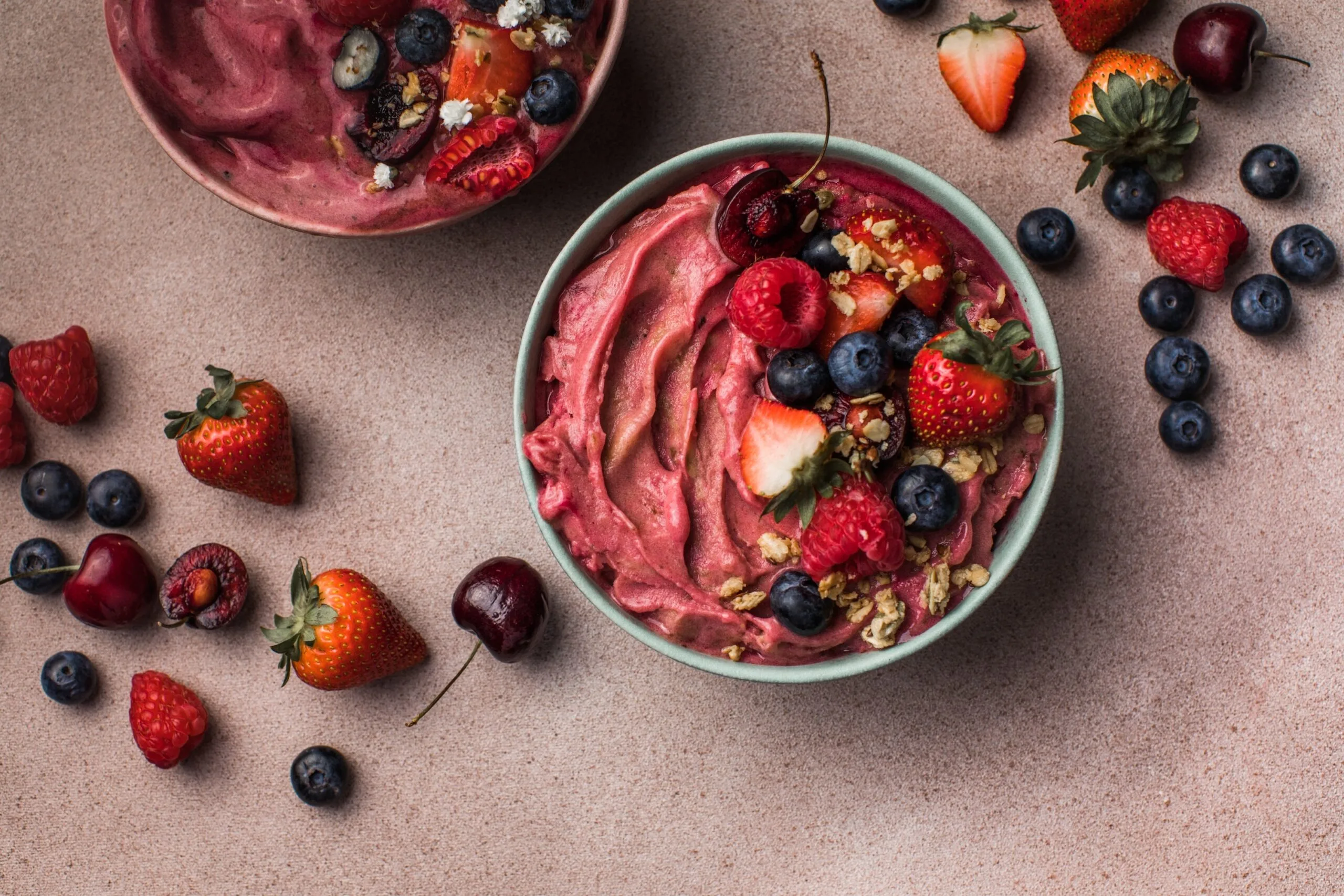
Açaí bowls have turned into one of the most photographed breakfasts around, showing up on café menus and social feeds for their deep purple color and thick, ice-cream-like texture. Part of the appeal is that they read as an antioxidant-rich, better-for-you alternative to a smoothie or a pastry, which has helped push the açaí berry from a regional Amazonian fruit into a global breakfast staple in about two decades.
The berry itself grows on a palm tree native to the Amazon rainforest, where it’s been a dietary staple. It’s about the size of a grape, made up mostly of skin and a large seed, with only a thin layer of pulp that gets separated out for food and drinks. Because the fresh berries spoil within a day of harvest, almost everyone outside the Amazon basin eats açaí as frozen puree, powder, or juice rather than the whole fruit.
That puree comes in sweetened and unsweetened versions, and the difference matters more than almost anything else in this dish: unsweetened puree has no added sugar, while sweetened versions and flavored packets can carry 15 grams or more per serving before a single topping goes on.
A single packet of unsweetened açaí puree has about 70 calories and 3 grams of fiber, which sounds like a reasonable start to a weight-loss breakfast. But the toppings—granola, honey, nut butter, dried fruit—routinely turn a bowl into a 500- to 800-calorie meal.
Here’s what the research on açaí itself says, and how to build a bowl that works with a calorie deficit instead of against it.
✅ Quick answer: Are açaí bowls good for weight loss?
It depends. It depends. A homemade açaí bowl made with unsweetened puree, fruit, and a measured portion of granola has about 350 to 400 calories, 11 grams of fiber, and a surprising amount of heart-healthy fat from the açaí itself. Unlike most fruits, açaí is naturally rich in monounsaturated fat, which contributes to its creamy texture. That makes for a balanced breakfast that can fit into many weight-loss plans.
The catch is that most bowls sold at cafés and restaurants use sweetened açaí puree, oversized portions, and calorie-dense toppings like extra granola, honey, nut butters, and coconut flakes. Those additions can push a bowl to 500 to 800 calories with 40 grams or more of sugar. If you’re watching calories, a homemade version made with unsweetened puree and portioned toppings is usually the better choice.
🚀 Açaí bowls: Weight-loss benefits
- Açaí bowls have a lot of fiber. A typical açaí bowl delivers around 11 grams of fiber from the açaí, banana, berries, and granola combined—nearly 40% of the daily recommendation in one meal. Fiber slows digestion and can help you feel full on fewer calories.
- You can build an açaí bowl to your specifications and health needs. Because açaí bowls are assembled from separate components, you control exactly how much granola, sweetener, and fruit goes into your bowl—something you can’t do with a pre-made smoothie or packaged cereal. This makes it easier to hit a specific calorie target than with many grab-and-go breakfasts.
- Açaí puree is low in calories. Unsweetened açaí puree provides plenty of water and fiber for its calorie count. Unlike most fruits, it also contains a modest amount of heart-healthy monounsaturated fat, which gives it its creamy texture. Building your bowl around more puree and fresh fruit—and less granola and syrup—can help maximize volume without dramatically increasing calories.
⚠️ Açaí bowls: What to watch out for
- Restaurant açaí bowls can be high in sugar. Commercial açaí bowls frequently use sweetened puree as the base and then add honey, agave, or fruit juice on top, which can push total sugar past 40 grams. If you’re not making it yourself, check whether the base is sweetened before you order.
- Açaí bowls are low in protein. A typical bowl, homemade or store-bought, has about 4 to 6 grams of protein, which might not be enough for a filling breakfast. Without protein, a high-carb, high-fiber meal like this can leave you hungry again within a couple of hours.
- Portion sizes at juice bars run bigger than they look. Many prepared bowls contain two to three standard servings in one container, so a bowl that looks like a single breakfast can carry 600 calories or more before you’ve added anything extra. Weighing or measuring your toppings at home is the most reliable way to avoid this.
🥗 Açaí bowls: Nutrition facts (per typical homemade bowl, about 340 g)
This reflects a standard homemade bowl: 2 packets (200 g) of unsweetened frozen açaí puree blended with half a banana, topped with ¼ cup granola and ½ cup mixed berries.
| Nutrient | Amount | % RDA* |
|---|---|---|
| Calories | 375 calories | — |
| Protein | 6 g | 12% |
| Total carbs | 51 g | 19% |
| Fiber | 11 g | 39% |
| Sugars | 20 g | — |
| Total fat | 15 g | 19% |
| – Saturated fat | 3 g | 15% |
| – Monounsaturated fat | 8 g | — |
| – Polyunsaturated fat | 3 g | — |
| Omega-3 | 0.2 g | — |
| Omega-6 | 2.5 g | — |
*Recommended dietary allowance (RDA) is defined as the average daily amount of nutrients needed to meet the requirements of nearly all healthy people in a specific group.
The standout nutrient here is fiber. At about 11 grams per bowl, it provides close to 40% of the daily fiber most adults need. That’s thanks to a combination of the açaí pulp, banana, berries, and granola, each of which contributes a few grams.
The fat is another strength. At about 15 grams, most comes from heart-healthy monounsaturated fat, largely because açaí is naturally rich in oleic acid—the same type of fat found in olive oil.
Where this bowl falls a little short is protein. With about 6 grams, it’s unlikely to keep most people full until lunch on its own. Pairing it with a source of protein—such as Greek yogurt, cottage cheese, hemp seeds, or a scoop of protein powder—can make it a more satisfying and balanced meal without changing the flavor very much.
💊 Açaí bowls: Vitamins and minerals (per 340 g serving)
| Vitamin/Mineral | Amount | % RDA* |
|---|---|---|
| Potassium | 670 mg | 14% |
| Vitamin C | 12 mg | 13% |
| Vitamin B6 | 0.2 mg | 12% |
| Magnesium | 40 mg | 10% |
| Iron | 1.5 mg | 8% |
*Percent RDA based on a 2,000-calorie diet.
While no single vitamin or mineral is exceptionally high, an açaí bowl provides a well-rounded mix of nutrients. Most of the potassium and vitamin B6 come from the banana, while the berries and banana supply most of the vitamin C. The granola contributes much of the magnesium and iron, especially if it contains oats, nuts, or seeds.
None of these nutrients reach a particularly high percentage of your daily needs on their own, but together they make a homemade açaí bowl a more nutrient-rich choice than many grab-and-go breakfasts, such as toaster pastries, donuts, or sugary breakfast cereals. The exact amounts will vary depending on the fruit and toppings you choose, so adding ingredients like pumpkin seeds, chia seeds, or hemp hearts can further boost the bowl’s mineral content.
🔍 Açaí bowls nutrient breakdown: Protein, fiber, carbs, and more
Glycemic index (GI) of an açaí bowl
Glycemic index: approximately 50–55 (Medium)
💡 Most of the glycemic impact comes from the granola and banana, while the fiber and healthy fats in the açaí help moderate the overall response. Swapping some or all of the banana for extra berries and using nuts or seeds instead of granola can lower the bowl’s glycemic index.
Is an açaí bowl high in protein?
❌ No. A typical bowl contains about 6 grams of protein, which isn’t enough to keep most people full until lunch. Most of that protein comes from the granola rather than the açaí itself.
💡 To boost the protein: Add Greek yogurt, cottage cheese, hemp seeds, or a scoop of protein powder.
Is an açaí bowl high in fiber?
✔️Yes. A typical bowl provides about 11 grams of fiber, with contributions from the açaí, fruit, and granola. That fiber is a mix of soluble and insoluble types, which helps support digestion and steady blood sugar.
💡 To boost the fiber: Add chia seeds or ground flaxseed for even more fiber with very little added sugar.
Is an açaí bowl low in carbs?
❌ No. A typical bowl contains about 51 grams of carbohydrates, mostly from the banana, granola, and naturally occurring fruit sugars. While those carbs come primarily from whole foods rather than refined sugar, the total may still be too high for people following a lower-carb eating plan.
💡 To cut the carbs: Replace some or all of the banana with extra berries and reduce the amount of granola.
Is an açaí bowl gluten-free?
✔️ It can be. Açaí puree, fruit, and most common toppings are naturally gluten-free. The biggest concern is the granola, since oats are often processed in facilities that also handle wheat. Choose a certified gluten-free granola or swap it for nuts and seeds if you need to avoid gluten.
Is an açaí bowl good for fat loss?
It depends. A homemade bowl made with unsweetened açaí puree and portioned toppings can absolutely fit into a fat-loss plan thanks to its fiber, fruit, and moderate calorie content. On the other hand, a large café bowl made with sweetened puree, extra granola, honey, or nut butter can easily contain twice as many calories. The deciding factor usually isn’t the açaí itself—it’s the portion size and toppings.
🍽️ Diet compatibility: Which diets include açaí bowls?
| Diet | ✅ / ❌ | Why |
|---|---|---|
| Keto | ❌ | At roughly 51 grams of carbs per bowl, a standard açaí bowl uses up most or all of a day’s carb allowance on a ketogenic diet. Even an unsweetened version built with banana and granola exceeds typical keto limits. |
| Paleo | ❌ | Granola made from oats and packaged with added oils falls outside most paleo frameworks, even though the açaí and fresh fruit fit fine. A paleo-style version would swap the granola for nuts, seeds, and coconut flakes. |
| Mediterranean | ✅ | Fruit, nuts, and seeds are all staples of the Mediterranean pattern, and açaí’s fat profile—mostly monounsaturated—lines up with the diet’s emphasis on unsaturated fats over saturated ones. |
| Vegan | ✅ | Açaí puree, fruit, and granola are all plant-based, making this an easy fit as long as any sweetener used is honey-free (maple syrup is a simple swap). |
| Gluten-Free | ✅ | The açaí base, banana, and berries are naturally gluten-free; the only variable is the granola, which should be labeled certified gluten-free if cross-contamination is a concern. |
An açaí bowl skews toward diets that welcome fruit and whole grains and away from lower-carb frameworks like keto. Vegan and gluten-free eaters have the easiest path, since the base recipe already meets both sets of restrictions with only minor label-checking required.
For paleo or lower-carb eaters, the fix is the same in both cases: swap the granola for a handful of nuts or unsweetened coconut flakes, and lean more heavily on berries than banana to bring the carb count down without losing the bowl’s texture.
🌟 Are açaí bowls healthy? What are the health benefits?
Metabolic health: Are açaí bowls good for your metabolism?
- Boosts metabolism? ❌ No. Despite marketing claims, there’s no good evidence that açaí increases your metabolic rate or helps you burn more calories at rest.
- Improves insulin sensitivity? Maybe. One small pilot study found that people who ate açaí daily for one month had lower fasting glucose and insulin levels. However, the study didn’t include a control group, so it’s impossible to know whether açaí caused the improvements. More research is needed.
- Reduces fat storage? Not proven. Laboratory and animal studies suggest that compounds in açaí called anthocyanins may influence how the body stores fat, but those findings haven’t been confirmed in well-designed human studies.
Cholesterol impact: Do açaí bowls affect cholesterol levels?
- Does it lower LDL (“bad”) cholesterol? Possibly. One small pilot study found reductions in total cholesterol and a borderline decrease in LDL cholesterol after 30 days of daily açaí pulp consumption. However, larger, well-controlled studies are needed to confirm the effect.
- Does it raise HDL (“good”) cholesterol? Possibly. One randomized crossover trial found that drinking açaí and juçara juice for four weeks increased HDL cholesterol in healthy adults.
- Overall impact on heart health? Promising, but preliminary. Açaí is naturally rich in anthocyanins and heart-healthy monounsaturated fat, and several human studies have reported improvements in antioxidant status or cholesterol markers. However, a 2025 systematic review found the overall evidence for improving cholesterol levels remains inconsistent.
💡 To make your bowl even more heart-healthy: Choose unsweetened açaí puree and add toppings like walnuts, chia seeds, or ground flaxseed, which provide additional fiber and heart-healthy fats while keeping added sugars low.
Can you eat an açaí bowl in a calorie deficit?
Yes. A homemade, portion-controlled bowl with unsweetened açaí puree (about 350 to 400 calories) can fit comfortably into most calorie-deficit plans, especially if you add a source of protein to make it more filling. A café bowl, on the other hand, can easily top 600 calories, taking up a much larger share of your daily calorie budget.
💡 Eating out? Ask for a half portion, skip added sweeteners, or share a bowl to bring the calories closer to a homemade version.
Are açaí bowls rich in antioxidants?
✔️ Yes. Açaí is naturally rich in anthocyanins—the same antioxidant pigments that give blueberries, blackberries, and red grapes their deep color. It has one of the highest antioxidant capacities measured in a fruit, although exactly how that translates to health benefits in people is still being studied.
Do açaí bowls support gut health?
Possibly. The fiber from the açaí, fruit, and granola helps feed beneficial gut bacteria. Animal studies also suggest açaí’s anthocyanins may promote a healthier gut microbiome, but this hasn’t been confirmed in people eating açaí bowls.
Do açaí bowls support digestion?
Yes. The bowl’s fiber—from the açaí, fruit, and granola—adds bulk to stool and helps support regular bowel movements.
Do açaí bowls help you feel satiated and less hungry?
Somewhat. The fiber helps slow digestion, but the relatively low protein content means the effect may not last as long as a higher-protein breakfast.
💡 To stay full longer: Add Greek yogurt, cottage cheese, hemp seeds, or a scoop of protein powder.
Do açaí bowls help with nighttime cravings?
❌ Not specifically. There’s nothing unique about açaí that targets evening cravings. If you’re eating an açaí bowl as a nighttime snack, adding protein may help make it more satisfying and reduce the urge to keep snacking afterward.
Do açaí bowls help reduce inflammation?
✔️ Possibly. One randomized controlled trial in people with metabolic syndrome found that drinking an açaí beverage for 12 weeks lowered two inflammatory markers compared with a placebo. While the results are encouraging, more research is needed to know whether homemade açaí bowls provide the same benefit.
Access GLP-1 Weight Loss with Noom
Explore a wide range of prescription medications supported by Noom’s program.Microdose GLP-1rx
Noom GLP-1rx
Noom GLP-1rx Plus
Wegovy®

Ozempic®

Metformin
Zepbound®
Mounjaro®
Liraglutide
Are açaí bowls beneficial for brain health?
❓Unclear. Animal studies suggest açaí’s antioxidants may help protect brain cells, but there isn’t enough human research to know whether eating açaí bowls improves memory, thinking, or other measures of brain health.
Can açaí bowls improve skin and hair health?
❓Unclear. Although açaí is rich in antioxidants, there isn’t good clinical evidence that eating açaí improves skin or hair health. Most claims are based on general antioxidant research rather than studies of açaí itself.
Can açaí bowls help balance hormones?
❌ There’s no evidence that açaí directly balances hormones. While eating a nutrient-rich diet supports overall health, no studies have shown that açaí changes hormone levels or relieves hormone-related symptoms.
💡 If you’re concerned about hormone-related symptoms, it’s best to discuss them with your healthcare provider rather than relying on a specific food.
🍽️ Best ways to eat an açaí bowl for weight loss
- Start with unsweetened puree and add your own fruit. Sweetened açaí packets can carry 15 or more grams of added sugar before any topping goes on, so building from an unsweetened base gives you full control over how sweet the bowl ends up.
- Add a protein source. Since a typical bowl only delivers 4 to 6 grams of protein, stirring in Greek yogurt, a scoop of protein powder, or a spoonful of nut butter is the single easiest way to turn a fiber-heavy bowl into one that actually holds you until lunch.
- Measure your granola instead of eyeballing it. A quarter cup of granola runs about 140 calories, but it’s easy to pour double that without noticing, which quietly adds another 100 to 150 calories.
- Avoid stacking multiple sweeteners. Honey, sweetened puree, and dried fruit each bring their own sugar load, and stacking two or three of them is how a bowl ends up with 40-plus grams of sugar. Focus on one sweetness source.
🍏 Açaí bowl vs. other bowls (per comparable 340 g serving)
| Food | Calories | Carbs | Fiber | Protein | Fat |
|---|---|---|---|---|---|
| Açaí bowl (homemade) | 375 | 51 g | 11 g | 6 g | 15 g |
| Greek yogurt parfait with berries and granola | 320 | 38 g | 5 g | 22 g | 8 g |
| Overnight oats with berries and chia | 340 | 48 g | 10 g | 11 g | 9 g |
| Cottage cheese fruit bowl | 260 | 24 g | 3 g | 24 g | 6 g |
| Plant-based protein smoothie bowl | 350 | 42 g | 9 g | 20 g | 10 g |
| Regular fruit smoothie bowl (no açaí) | 330 | 55 g | 6 g | 5 g | 8 g |
An açaí bowl stands out for its fiber content and healthy fats, providing more fiber than most alternatives and nearly as much as overnight oats. It’s also one of the few breakfast bowls that’s naturally rich in anthocyanins—the antioxidant compounds that give açaí its deep purple color. The biggest drawback is protein. At about 6 grams, it contains much less protein than a Greek yogurt parfait, cottage cheese bowl, or protein smoothie bowl, all of which provide 20 grams or more.
If you’re looking for a plant-based, high-fiber breakfast, a homemade açaí bowl is a great choice—especially if you add a source of protein like Greek yogurt, protein powder, hemp seeds, or cottage cheese on the side. If your top priority is staying full for several hours, a higher-protein option like a Greek yogurt parfait or cottage cheese bowl may be a better fit. Ultimately, no single breakfast wins across every category. The best choice depends on whether you’re prioritizing fiber, protein, antioxidants, or overall calorie intake.
❓ Frequently asked questions about açaí bowls and weight loss
How many calories are in a typical açaí bowl?
A homemade bowl made with unsweetened açaí puree and modest toppings typically contains 350 to 400 calories. Café versions often range from 500 to 800 calories because they use larger portions, sweetened puree, and calorie-dense toppings like extra granola, nut butter, and honey.
Can I eat an açaí bowl every day?
Yes. A homemade açaí bowl can be part of a healthy daily routine, especially if you use unsweetened puree, watch your portions, and include a source of protein. Like any meal, it’s important to consider how it fits into your overall calorie and nutrient needs.
Are açaí bowls high in sugar?
It depends. Unsweetened açaí puree contains very little naturally occurring sugar. Most of the sugar in a homemade bowl comes from the fruit and granola, while café versions often contain added sugars from sweetened puree, honey, or syrups. As a result, a homemade bowl may contain around 20 grams of sugar, while some commercial bowls can exceed 40 grams.
Is a homemade açaí bowl better than one from a smoothie shop?
Usually. Making your own bowl lets you control the portion size and choose an unsweetened açaí puree. Many smoothie shops use sweetened puree and generous portions of granola, honey, and other toppings, which can significantly increase the calories and sugar.
Can açaí bowls fit into a low-carb or keto diet?
Not in their traditional form. A typical bowl contains about 51 grams of carbohydrates, which is too high for most keto diets. However, a lower-carb version made with unsweetened açaí puree, extra berries, nuts, seeds, and little or no granola may fit a more moderate low-carb eating plan.
Are açaí bowls good for people managing blood sugar?
They can be. A homemade bowl made with unsweetened açaí puree, plenty of berries, and a moderate amount of granola falls into the medium glycemic range. Pairing it with a protein source and limiting higher-carb toppings can help support a steadier blood sugar response.
Can I use frozen açaí packets from the grocery store, or do I need a special product?
Frozen unsweetened açaí packets are the best choice for most people. They’re widely available, minimally processed, and provide the same fiber and nutrients as other forms of açaí. Powdered açaí products are mostly a matter of convenience and don’t offer clear nutritional advantages.
🧠 The bottom line: Açaí bowls can be a good option for weight loss
Açaí bowls can absolutely fit into a weight-loss plan, but how you build the bowl matters. A homemade bowl made with unsweetened açaí puree, a measured serving of granola or nuts, plenty of fruit, and a source of protein comes in at about 350 to 400 calories while providing 11 grams of fiber, healthy fats, and a variety of vitamins and antioxidants. That combination can make for a satisfying breakfast that fits well into a calorie deficit.
The version to watch out for is the café bowl. Sweetened açaí puree, oversized portions, and generous toppings like extra granola, honey, and nut butter can quickly turn it into a 600- to 800-calorie meal with more sugar than a can of soda. If you’re trying to lose weight, the simplest strategy is to choose unsweetened açaí puree, be mindful of portion sizes, and prioritize fiber and protein over extra sweet toppings.
📖 Scientific evidence on açaí bowls and weight loss
- Açaí was associated with improvements in metabolic risk markers. (Nutrition Journal, 2011) In a small pilot study, people who ate 100 grams of açaí pulp twice daily for 30 days had reductions in fasting glucose, insulin, and total cholesterol, along with a smaller rise in blood sugar after a standardized meal. Because the study had no control group, the findings suggest a possible benefit but don’t prove that açaí caused the improvements.
- Açaí was linked to lower levels of inflammation. (Food & Function, 2018) In a study, people with metabolic syndrome who drank an açaí beverage twice a day for 12 weeks had lower levels of two markers of inflammation and oxidative stress than those who drank a placebo beverage.
- Açaí was linked to higher HDL (“good”) cholesterol levels. (Clinical Nutrition, 2020) In a study, healthy adults who drank açaí and juçara juice for four weeks had higher HDL cholesterol levels and improved antioxidant defenses compared with a control period.
- Açaí may help support a healthy response to inflammation during a reduced-calorie diet. (Clinical Nutrition, 2020) In a study, people with overweight and high cholesterol who followed a reduced-calorie diet and ate açaí pulp had greater improvements in markers of inflammation and oxidative stress than those who followed the diet alone. This suggests that açaí may provide additional benefits beyond the reduced-calorie diet itself.
- Research on açaí and cholesterol is still mixed. (Nutrition Bulletin, 2025) A review of eight human studies found that some studies showed benefits, but overall, açaí didn’t consistently improve cholesterol or triglyceride levels. More research is needed to understand whether it can help support heart health.
Editorial standards
At Noom, we’re committed to providing health information that’s grounded in reliable science and expert review. Our content is created with the support of qualified professionals and based on well-established research from trusted medical and scientific organizations. Learn more about the experts behind our content on our Health Expert Team page.